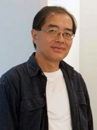
text by Ong Chin-Sheng
I can recall few dreams that I dreamed in the night. But I daydream a great deal, perhaps too much. Because of daydreaming, I believe I practically do not need dreams to help me sleep in the night.
Scenes of dreams in my artwork, therefore, came from my daydreams. They are realities of memories and fantasies, having as much to do with actualities as with non-actualities, with lights as with shadows, and with love as with curiosity. These moments of correspondences were evoked by radiances and sounds, as well as by babies’ smiling faces. They were influenced by bad and depressing dreams, too. Time also deepened their contents, eventually making them rich and dynamic.
It seems futile to speak of dreams and artwork in written words. In verbal explanations, words, dreams, and artwork each go their own ways. The dreams-in-art remain untouched in the end. In a way, the situation is like Ch’an (zen), revealing itself only by hints, not by semantic elaborations. The worlds of dreams are vast, taking their origins from every direction. My drawings and paintings of dreams, largely from concrete shapes, also rely heavily on colors and space. At times, a simple color or form is all that is needed.
To dream means to transcend, to deliver, and sometimes to work through thorny messes. Working on dreams in art gave me a sense of pleasure, in the process of which the past was reactivated. Sometimes my dream-work came from naught, inspired by sounds and colors captured from moments of impressions. These materials belonged to times fleeting as well as times lingering.
Possibly on account of the influences from photography and cinema, my dream-in-artwork effects as if it were accompanied by music and subtitles. It also carries a sense of speed. It is more than visual, hiding its secrets in the concept of structure. The onset of ideas and moves closely responds to climates, surroundings, and their aura; any subtle changes of temperature or shade affect the outcome. My dreams have physical roots. The dream scenes of my work contain hidden seasonal messages of nature, together with joy or sadness felt at the moment.
Many of these scenes have something to do with the fact that I have lived in the mountains for a long time. Indeed, there are apparent elements of nature, clouds and shadows in particular, that one can easily identify in my work. These elements are more than nature in actuality; they are wedded with the humans, even something of the cities. Ultimately, they perhaps delineate a space beyond the limits of nature or city, making comments on a lone self, or finding an outlet for the dilemma in a certain period of my life.
There is a difference between my present work and the work of earlier times. Earlier, both dreams and realities were intimate to me; the world remained rather concrete. In recent works, I tend to see the felt world in foils. Memories are connected with fantasies now. Meanwhile, music rises, merging them into an ineffable state of mystery. There were periods in which human shadows and winding roads were frequent motifs in my vision. Also present were skies and clouds in geometric forms, together with vague images of animals. All of them gradually faded away. I don’t know why. Artists can’t always explain their work.
I let this state of things persist, let the knowable and the unknowable remain non-obstructive to each other. I waited for ideas and urges of art to call on me, just as they waited for me to call on them. The two parties worked as a master and his dog would do. They became ever familiar with each other, achieving deeply reciprocal understanding. And I imagine that, as both became really old in age, they could communicate with each other by a mere glance, no need of words.
I am not quite certain if “dreams” and “fantasies” are the right words for the content of my work. They don’t seem to tell in complete terms all my visions and inner stirrings. But “dreams” and “fantasies” are images close to each other, one connecting with my sleeping state, the other, my wakefulness of a sort. These art pieces have been worked upon over a long period of time. They are not to be fitted into the verbal frames that I provide for them here. Rather, they should tango with what the words connote. |
|